

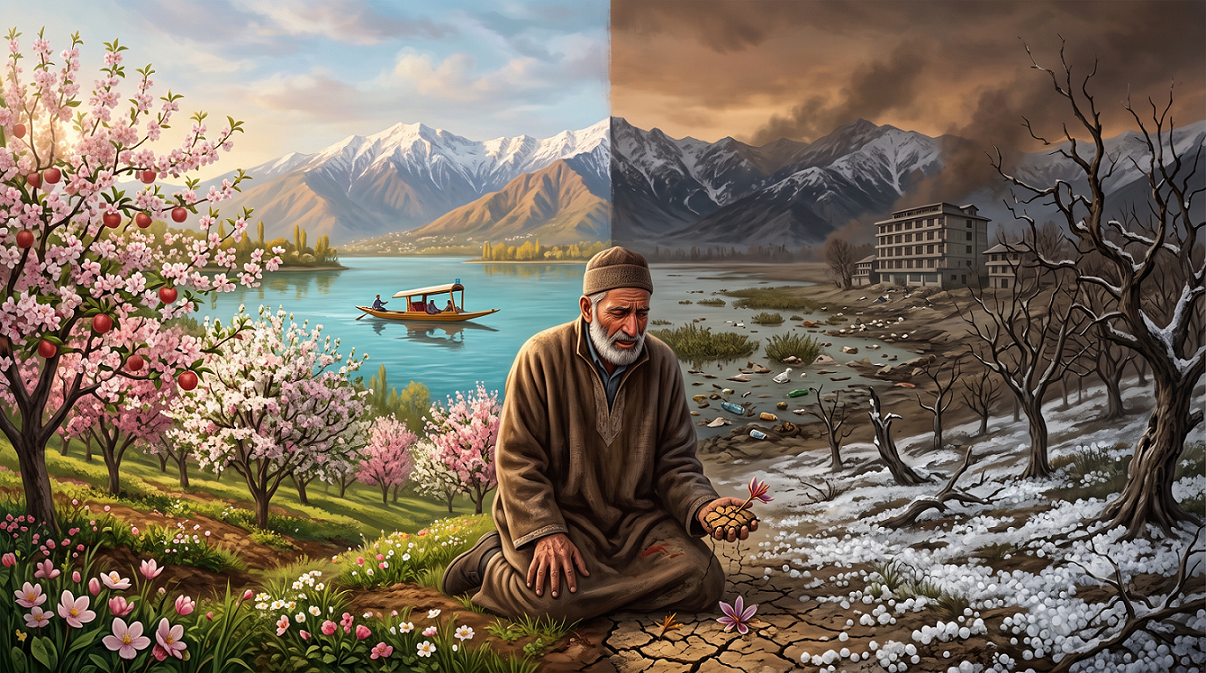
I grew up listening to my grandmother describe the rhythm of our valley—a rhythm so precise you could set your life to it. Forty days of harsh winter chill (Chillai Kalan), followed by a softer cold, then the burst of almond blossoms, the neat rains of spring, the temperate summer, and the golden autumn that draped the chinar trees in fire. That rhythm was not just poetry; it was our livelihood. It dictated when we sowed our paddy, when our apple trees needed pruning, when the saffron fields would bloom, and when the shikaras would glide on a full Dal Lake.
Today, that rhythm has fractured. The Kashmir I see outside my window is increasingly unrecognizable. And while global climate change is a culprit, the more painful truth is that our own hands have accelerated this unravelling. We have interfered so deeply with the land, water, and forests that the climate is no longer behaving as it once did—and the consequences are stealing our livelihoods, one erratic season at a time.
What we did to the land
The valley’s wetlands and floodplains, which once acted like giant sponges absorbing excess water and releasing it slowly, have been sacrificed for housing colonies, malls, and unplanned urbanization. The iconic Dal Lake has shrunk, choked by encroachment and pollution. We deforested vast hillsides for timber and firewood, breaking the chain of cloud formation that once guaranteed our rains. We concreted over the streams and springs, blocked the natural drainage, and replaced paddy fields that were crucial for groundwater recharge with lucrative apple plantations that drink the soil dry and load it with poisonous fertilizers and pesticides.
Add to this a tourism model that runs without limits—concrete hotels in eco-sensitive zones, diesel generators humming in alpine meadows, plastic waste buried in glacial streams—and you have a recipe for a climate catastrophe that is entirely local in origin.
How the climate is hitting back
The winters are no longer cold enough. Snow that once sealed our glaciers and fed our perennial rivers now either comes late, melts too quickly, or never arrives at all. Heatwaves in June now wilt the apple orchards; unseasonal hailstorms strip the blossoms in March. The famed forty days of harsh winter have turned into a few days of slush. In the autumn of 2023 and 2024, we saw prolonged dry spells that left our streams and springs—sacred lifelines for drinking and irrigation—cracked and silent well before spring.
The glaciers are retreating, and the great Jhelum, which nurtured civilization here, now swings between bone-dry stretches and sudden, devastating floods, like the 2014 deluge that submerged large parts of Srinagar. That flood was not a natural calamity alone; it was a consequence of decades of choking the river’s lungs and building over its memories.
Livelihoods on the edge
This climate chaos is not abstract. An apple farmer in Shopian will tell you how his orchards are shifting higher up the mountains because lower altitudes no longer provide enough winter chill. The saffron fields of Pampore are shriveling under erratic rain and rising temperatures, yields dropping to an all-time low. The kashidakari artisan who depends on a steady supply of water for processing threads, the fisherman on Wular Lake, the shikara wala who waits for tourists amid dried-up water channels—each story is a ledger of loss. When the climate behaves differently, the land can no longer support the dreams attached to it. Farm debts rise, young men migrate to cities for construction work, and a culture slowly withers.
The silence we need to break
Human intervention did not begin yesterday. It was a slow creep—a legalized encroachment here, a blind eye to deforestation there, a development plan that valued concrete over ecology. Reversing this demands that we stop seeing wetlands as “wasted land” and hillsides as “real estate.” We must resurrect our traditional water management systems, enforce strict bans on floodplain and forest exploitation, and accept that tourism cannot come at the cost of our life-support systems.
The sky over Kashmir still holds a fragile blue, the chinar leaves still turn crimson in October, and the spring still tries heroically to announce itself with a few stubborn blossoms. But if we do not mend our relationship with the land, the next generation will only hear about these seasons through the fading stories of their grandparents. And by then, the loss will be too quiet and too absolute to reverse.
Our climate is not just changing; we changed it. It’s time we change ourselves.